Showing posts with label Michael McCreadie. Show all posts

Wednesday, December 21, 2011

Michael McCreadie quits international stage

Scotland's Michael McCreadie has announced his resignation from international competition.

"I am no longer a member of the World Class Performance Squad," he told me. "Since the summer, although playing reasonably well and achieving some good results in International competitions, my heart wasn't in it any more - the enjoyment had gone. It was not an easy decision to make. I had to do what was best for me and ultimately the squad.

"I wish the coach and the squad every success in the future." 

Tony Zummack, the national coach, responded: "I do feel that Michael McCreadie will continue to be involved and support wheelchair curling in the future. I respect his decision to retire from international competition and also respect the time and commitment he made to the National Program."

Michael, 65, was a member of the Scottish team that contested the first World Championship in Switzerland, 2002, where he won a bronze medal playing 2nd under Frank Duffy. He won gold medals playing 3rd at the 2004 and 2005 Worlds, and was the British flag bearer in Torino in 2006 where he won silver.

He followed Duffy into retirement after the crushing last rock Torino defeat, but was soon back and skipped his country to bronze at the 2007 Worlds, a success that eluded his teams the following 3 years.

After the Vancouver Paralympics, where he skipped but threw 3rd stones, he announced he would take a year off. He returned this season, but with the Scottish team committed to his partner Eileen Neilson at skip after her silver medal at the 2011 Worlds, his role was to skip Scotland's B team. That is the position he has now quit.

Zummack is not immediately replacing him. "I am keeping the National Squad at 7 athletes and have had some of our development athletes come in to train and play with us and will have someone in place for the Lanarkshire International." (Jan 17-18)

Michael McCreadie played in 72 World Curling Federation events, ending with a 45-27 record, 2 gold and 2 bronze Worlds medals and a Paralympic silver medal.

Thursday, May 19, 2011

Michael McCreadie back in Scotland's plans for 2014

When Michael McCreadie stepped down as British and Scottish skip after the team's disappointing run of performances up to and including the Vancouver Paralympics, he said he hoped to rejoin the program at a later date.

McCreadie continued to compete with some success on domestic teams skipped by partner Aileen Neilson, and the promise of significant changes to the national team's approach to the game under new National Coach Tony Zummack, prompted him to apply to the 2011-2012 Wheelchair Performance Program.

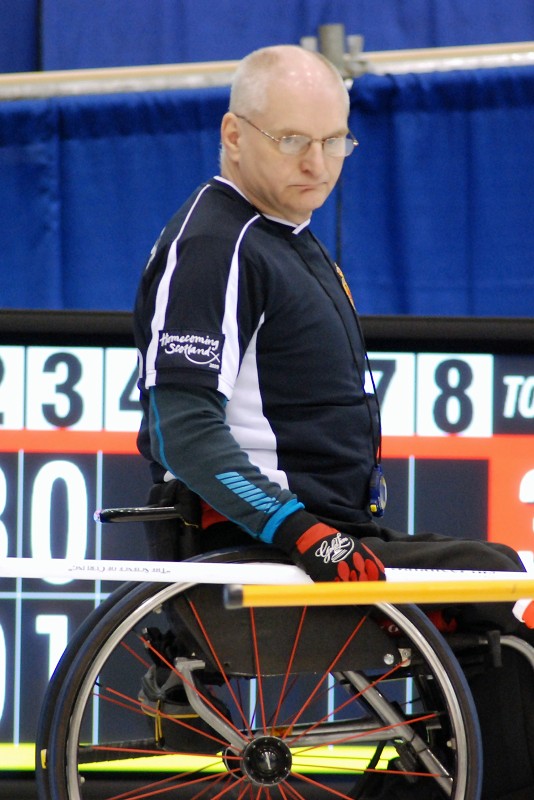
Michael McCreadie at the 2009 Worlds


The eight athletes selected are Aileen Neilson, Tom Killin, Angie Malone and Gregor Ewan from the 2011 Worlds silver medal team, Michael McCreadie, and newcomers Jim Gault, Ian Donaldson and Gill Keith.

2011 World's silver medallist Michael McKenzie missed out but will have an opportunity, along with the other unsuccessful applicants, to be considered for the Scottish Wheelchair Curling Association's 'Spokes' Development Program.

The talent identification and development effort promises to be an on-going process, providing incentives not only to current members to develop their skills, but to those who may yet challenge for a place on the Sochi Paralympics team in 2014.

Saturday, January 22, 2011

Michael McCreadie playing for Scotland in England

Fenton's Rink, located near Tunbridge Wells in Kent, south-east of London, is the only curling ice rink in England. This weekend it is the site of the Four Nations Competition, hosted by the English Curling Association, between teams from Scotland, England, Wales and Ireland.

Skipping and throwing 3rd stones for Scotland in the Tom Ballantyne Trophy competition (highest aggregate score over five games against England in the year) was Michael McCreadie, playing with Stephen McClymont, Graeme Maguire and Gerry Crighton.
Skip Michael McCreadie with 4th stones thrower Stephen McClymont
[photo - Bob Cowan]

Michael also skipped Scotland's Mixed Team against Wales.
 Michael McCreadie with teammate Liz Jamieson
watched by Ernest Fenton, owner of the rink

[photo - Bob Cowan]

Friday, December 24, 2010

McCreadie wants back in

Bob Cowan, who follows wheelchair curling in Scotland, has a blog post introducing Tony Zummack, but he buries the lede.

Michael McCreadie, who stepped up from 3rd to skip Scotland/Great Britain when Frank Duffy retired after Torino, and then took a sabbatical from international play after Vancouver, says he wants to be part of the new Scottish program.

Cowan quotes McCreadie: "I encountered Tony and his Alberta Team at the Richmond International in Vancouver in 2008. Alberta won the competition beating Jim Armstrong's team in the final.

"Tony comes to Great Britain with knowledge and experience of coaching wheelchair curlers at high level - his record speaks for itself. I am excited and feel sure he will bring his own methods, strategies and coaching expertise to enhance the skills of present and future players. This is a fresh start for all a journey which I hope again to be part of. The selection panel should be congratulated in their choice of coach."

Sunday, November 28, 2010

Scots take to the road

The Scottish Wheelchair Curling Association is planning a series of Roadshows this season, travelling to various clubs describing all the competitions and pathways available for wheelchair curlers and coaches to advance their skills.

First stop was last Saturday at the Borders WCC in Kelso where SWCA Chair Judy Mackenzie and Players’ representative Michael McCreadie talked about the new Skills Awards and the Shotmaker initiative, before taking players and coaches onto the ice for some practical tips.

This initiative is a good demonstration of what can come from empowering players to help guide the sport. Established Scottish players see it in their interest to grow participation. Wheelchair curlers have formed their own clubs within clubs, as have some in Canada, the better to organise and advertise their activities. At the Star Refrigeration National Pairs event, most of the established Scottish players paired with less experienced partners.

Canadians obviously face distance challenges for it to be easy to travel as wheelchair curling evangelists, but they can perhaps learn something from the player inspired initiatives underway in Scotland to nourish the game at the grassroots.

Sunday, October 24, 2010

Shotmaking skill is the focus in Scotland and Canada

Michael McCreadie, though taking a break from international competition, remains very much involved in the sport. His latest project is a recently announced Shotmaker Competition, organized through the Scottish Wheelchair Curling Association.

The competition asks curlers to complete a series of drills at different locations, the highest scores to be submitted to the SWCA and a prize awarded for the player with the best cumulative score when adding their best result from each of three venues.

"The idea is to have a fun competition that raises awareness of shot-making that I think will carry over into regular play. If people practice specific shots their skills will improve, and so will their performance in games," Michael assured me.

"At the end of the season, not only will there be a winner, but the twelve best performances will earn an invitation to a Shotmaker event in Kinross."

The competition begins in November. You can read full details of the drills and the thinking behind the competition by downloading the aims, objectives and tests. You can register an interest in entering by filling out this form. 

Though ambitious curlers will already throw a range of specific shots during practice, charted drills allow coaches to gauge progress and compare athlete performances. That is a large part of the thinking behind the Team Canada booklet just released by coach Wendy Morgan to assist in the talent identification and player development program that will be taking place in venues across Canada this season.

Athletes who think of themselves as national program candidates, will have the opportunity to display their skills by performing a series of drills described in the booklet.

I can see the utility of scored drills in bringing someone who might otherwise be overlooked, to the attention of coaches. And I concede to Michael that anything that encourages structured practice has to be a good thing, if you practice as you play, as I have warned previously. (3rd paragraph)

But I remain sceptical about how useful drill totals are in judging potential game performance. For one thing, players on a four person team have lengthy waits between pairs of throws.

Every coach I have spoken to say their players have an inflated opinion of how accurate they can be in competition. High practice percentages are rarely seen in game situations.

Yes, practice will improve performance and drills can offer a framework that can make practice more disciplined and more efficient. In the context of Michael's shotmaker competiton it can also be more fun.

But I would not weight the on-ice performance element of my team selection on drill scores. I'd want to know how curlers can throw under pressure; perhaps by choosing, unannounced, single shots from a game where the curler is told just before they throw that this shot will become part of their record.

If all shots are charted, no shot is special and if all shots matter, then none matter. Matches are not like that.

Perhaps you'd like to share in the 'comments' how you practice, and what records you keep, and how you can tell whether you are improving as a player.

Thursday, September 2, 2010

Michael McCreadie leaving national team


Team Great Britain skip Michael McCreadie was a notable absentee from the list of individual athletes selected to the British Wheelchair Curling Squad for Season 2010 - 2011.  Gregor Ewan, Jim Gault and Michael McKenzie join recent team members Tom Killin, Rosemary Lenton, Angie Malone, Aileen Neilson and Jim Sellar.

There was no mention whether Tom Pendreigh remains as coach.

Bob Cowan reports Michael saying, "I have decided to take a season out of international competition and re-assess next season."

Expectations of success are as high in Scotland as in Canada. Michael was unable to repeat, as leader of the generously sponsored program, the success he enjoyed as vice to Frank Duffy, and admits the pressure of the past couple of years affected his enjoyment of the sport. Read Bob's report HERE.

Tuesday, June 29, 2010

Braehead curlers in charity wheelchair push

photo - Aileen Nielson]
Bob Cowan reports that members of the Braehead WCC held a sponsored 10 mile wheelchair push to raise funds for Erskine Hospital.

Michael McCreadie said, "For the past five years we have raised money for our own club. However, this year we felt it appropriate that another worthwhile organisation should benefit."

Tuesday, March 16, 2010

USA tied at top of table as Canada crash to Sweden

It too an extra end after USA surrendered 3 in the 8th against Great Britain (1-4), but USA (4-1) pulled out an 8-7 win to tie Canada at the top of te table at the end of Day 3 at the Paralympic Games.

Canada (4-1) surrendered their unbeaten record in an 8-4 loss to Sweden. Read match report HERE. Norway stopped Korea's momentum, winning 9-6 and Germany lost to Switzerland 9-3.

Michael McCreadie said after the team's 4th loss (to USA) "It can be a cruel game at times. Although we are losing the team dynamics remain strong. Aileen is an excellent last rock thrower. There's such a small margin between winning and losing, but we are still thinking playoffs if we can win the rest of the way. The ice was very swingy today, but we just have to adapt to the conditions."
 Michael McCreadie
Read article on McCreadie by Lyndon Little HERE

Heavy ice was also on Swedish skip Jalle Jungnell;s mind,though he pulled off wins over two favoured sides today (Norway and Canada). "We tried to play our normal game, "he said, "but we've been struggling with the ice. It's so heavy."

That was a sentiment echoed by Norwegian skip Rune Lorentsen. “It’s tricky ice. I don’t know the feel of the rocks. We do the same things as other teams but our rocks don’t behave the same. It makes us a little unsure. [Against Sweden] we always play crappy matches. No good play and we were very nervous.”

Table leaders Canada and USA each play a single game tomorrow; Canada against Switzerland in the morning and USA against Sweden in the evening.

Saturday, March 13, 2010

New to wheelchair curling? Watch this video

BBC Sport has a series of videos introducing wheelchair curling and also the members of the wheelchair curling team.

Michael McCreadie, skip of Team Great Britain, was the only curler to be given the honour of carrying his nation's flag at the Opening Ceremonies of the Vancouver Paralympics.


In the video below he gives a full explanation of how wheelchair curling is played, ending with encouragement for people to come out and try the sport. There's lots of people who will help, he says, concluding:"Give me a call and I'll turn up also."

One interesting note from the video: they edited in the last rock thrown by Frank Duffy from the Torino Games, where Great Britain had an open hit to win gold. It starts at 2.00 into the video.

Other videos including video profiles of Team GB curlers, can be found HERE.

Saturday, March 6, 2010

GB's McCreadie hints at retirement (again)


Four years ago, just after Great Britain saw the gold medal they had been favourites to win, flash away with their last rock. skip Frank Duffy and 3rd Michael McCreadie announced their retirement from competitive wheelchair curling.

Frank did quit, but Michael, who'll be 64 on March 16th, soon re-stoked the competitive fires. Next week extends a Paralympic career that began in the pool 38 years ago in ago in Heidelberg, Germany, and continued with bowls, wheelchair basketball and now curling.

"It's good to know that talent is still there from way back then," he told The Press Association's Matt McGeehan.

"(Vancouver gold) would be one of the greatest achievements of my career and maybe a good time to say bye-bye."

Read the interview HERE.

Saturday, February 27, 2010

BBC Sport introduces GB's professional wheelchair curlers

The BBC sent a reporter to Stirling to watch Team GB prepare for the Paralympics. As he mentions, curling is the winter Olympic sport that captures the attention of the British public, and after the struggles of the GB Olympic teams, the pressure will be on the McCreadie rink, described as professional wheelchair curlers.


In the video you can see them delivering from in front of the hack as opposed to near the hogline. WCF rules say that the stone at delivery played from between the hack and the top of the rings, must touch the centre line. Stones played between the top of the rings and the hogline can be up to (approx.) 6 inches from centre, the outer edge of the stone within 18 inches of the centre line.

Friday, February 26, 2010

GB's McCreadie "quietly confident of gold"

Jim Sellar, Angie Malone, Michael McCreadie, Aileen Nielsen, Tom Killin
[photo - Martin Shields - Evening Times]

Team Great Britain skip Michael McCreadie told reporters assembled at the team send off celebration at their teams home ice at Braehead: said, “We’re quietly confident of bringing home the gold medals.”

Bob Cowan reports Michael saying: "If we play at our best we will be a real handful for any country in the world .... The GB Paralympic teams work just as hard all year round and prepare for our winter games just as much as the competitors who are presently out in Vancouver for the Winter Olympics.”

You can read the rest of Bob's report HERE.

Also a report from the Paisley Express.

Though the GB team, all Scots, have as much experience and as many medals as any team in the world, for the past two years they've been undertaking what Tom Pendreigh their coach calls a "skill acquisition project." This has included throwing from the top of the rings rather than the near hogline.

Pendreigh expressed surprise when I contacted him last week at the skepticism his project has provoked from those outside his program. He's certain of its advantages and feels his team has overcome "expected and managed" performance dips in the run up to the Paralympics.

GB plays Canada in the first draw, and a good result will give McCreadie, who is still inexperienced at skip, all the confidence he needs to reach the podium.

Saturday, November 21, 2009

Fairness demands two-tier participation - Michael McCreadie


Team GB skip Michael McCreadie, seen here at 2009 Worlds
photo - Yadranka

Team Great Britain skip Michael McCreadie is one of the world's most experienced wheelchair curlers, with decades of participation in other wheelchair sports. He feels that the time has come for the introduction of a two-tier classification that will force inclusion of more severely disabled wheelchair users onto teams competing under WCF rules.

"The original rule is a real strength of wheelchair curling. The game was established for players who use a wheelchair for “daily mobility”. Players within the sport, in my view, wish that original ethos to be maintained and strengthened," he says in a discussion document being circulated prior to the WCF semi-annual meeting set for Aberdeen in December to discuss possible rule changes..

"I am aware," he continues, "that classification attempts to confirm player eligibility and then seeks to assign individual players to a sports specific class. I believe the time is right for Chief Classifier (Dr Andrew Burt) and other experienced classifiers to identify minimum disability criteria for our sport as opposed to classification on a player by player basis."

He then proposes a radical change of rule regarding participation. Teams playing under WCF rules would be forced to include more severely disabled wheelchair users, the people at present being excluded from national teams focused solely on fielding the best athletes, rather than considering encouraging participation at all levels of disability.

"Most teams currently comprise of the most able wheelchair curlers who use a wheelchair for daily mobility. In the beginning there was the opportunity for more severely disabled players to compete for national team places. As the sport has developed across the world and the quality of play has improved, the most physically able players have started to dominate," McCreadie says.

"In the absence of divisioning within the classification system tetraplegic players, players who use power wheelchairs and those with cerebral palsy will continue to be non competitive in the current open class system. I believe the time is right to introduce fairness into the sport along the lines of what currently exists in team boccie (teams comprise of at least one class 1 player). Each team should in the future include one player who qualifies for a class that is representative of more severely physically disabled players. It may be as simple as introducing two classes into the sport for all players who are eligible. Class 1 would be the open class for all eligible players. Class 2 would be for players who are tetraplegic, players who are in the advanced stages of MS, some players with cerebral palsy or players with severe upper limb weakness or limb loss etc.

"I am not an expert in this area but I am certain that experienced classifiers could come up with appropriate profiles. In speaking to fellow national and international players I believe there is support for the introduction of a two tier system of classification that encourages, develops and retains the involvement of wheelchair players with more severe physical impairments while at the same time ensuring it retains its original aim of being a sport for non ambulant players only."


It is undeniable that where teams are selected by national associations seeking the best chance for a medal in return for their financial support, wheelchair curling has become a sport geared to the most athletic. Indeed, it was specifically mandated by Canada's "Own The Podium" program, a major funder, that the selectors choose the best available athletes, and then coach them to excellence.

The question is whether that is bad for the sport, and if it is, does mandating inclusion of players of less physical strength serve a useful purpose? Michael thinks that it does.

"It's all about participation, Eric," he told me when I expressed some scepticism about his solution. "We have to avoid the idea that unless you are some super-fit paraplegic or amputee, then it's not worth trying wheelchair curling because you have no chance of being selected for representational play."

But even if one agrees that allowing coaches and selectors to exclude all but the best athletes is bad for the overall development of the sport, is creating artificial categories beyond stating minimum wheelchair usage requirements a plausible solution?

It is worth noting that Germany's 2009 World Championship bronze medalists included a third, Marcus Sieger, who because of his level of disability would probably not have been considered for Canada, or Scotland, or Norway or for any of the teams centrally selected. He won his place because Team Germany were essentially a self-selected club side. Yet it would be hard to imagine that a physically stronger draftee would have performed more valuably.

(I admit to a prejudice against classification. I don't like the idea of being defined as a smaller percentage of someone else. I'd rather be 100% me. I also suspect classifications are at best subjective and at worst corrupting.)

The actual proposal for changing eligibility, to be presented by WCF vice-President Kate Caithness at the December meeting, suggests expanding participation beyond users who require a wheelchair for daily mobility, to include anyone with (specified) significant ambulatory impairments who is unable to curl without using a wheelchair.

My response to Michael's exclusion concerns would be to set a minimum wheelchair usage requirement and do away with central selection, which is the engine of exclusion, even at the cost of financial support for the favoured few.

Allow teams to come together, and those with the ability and ambition will find the resources to fulfil their dreams. The present system makes athletes nationalistic totems, surrogates for the political ambitions of their associations or the careers of their coaches. So maybe selection wins your country a medal. A week later, who other than the athletes, their parents and their enablers, cares?

You can read the full text of Michael's document, as written, as the first comment below. A response by Judy Mackenzie follows.